__LOGO-03.png)
__hanoi-water-puppets.jpg)
__angkor-wat-blue-reflections.jpg)
__vientiane-buddha-park-monks.jpg)
Exploring the Northwest region of Vietnam: Things to know before traveling
2The Northwest region of Vietnam appeals to tourists through its majestic mountainous landscape, misty villages, cloud-covered passes, stunning terraced rice fields, beautiful flowers, and ethnic people’s friendliness. Traveling to the region allows you to immerse yourself in the natural scenery, learn about the local culture, and relax. Let’s explore the region with Handspan Travel!
Through this blog post, you will find the following pieces of information.
- General information about the Northwest region of Vietnam
- The ideal time to visit the Northwest region of Vietnam
- Exploring outstanding destinations in the Northwest region of Vietnam
- Enjoying specialties in the Northwest region of Vietnam
- Tips to know before traveling to the Northwest region of Vietnam
General information about the Northwest region of Vietnam
The Northwest region of Vietnam has six provinces. They are Lao Cai, Lai Chau, Yen Bai, Dien Bien, Son La, and Hoa Binh. This region has a total area of about 5.645 million hectares, accounting for 10.5% of Vietnam’s total area. Besides magnificent landscapes, this region also has many ethnic cultures. Thai and Muong ethnic groups make up the largest percentage in the Northwest. Besides, the Northwest region of Vietnam is also home to many other ethnic minority groups. They are the Hmong, Dao, Tay, Kinh, Nung, etc.
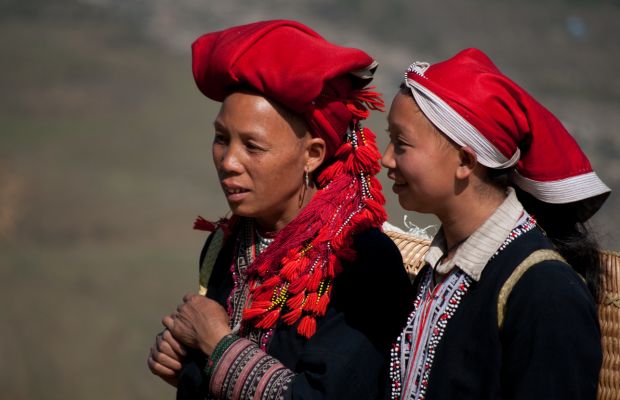
Red Dao women in Sapa
The Northwest is a region with a very clear distribution of population according to altitude. The highlands (mountain tops) are home to ethnic groups belonging to the Mong - Dao, depending on nature to do farming. The mountainous slopes are home to ethnic groups belonging to the Mon-Khmer language group, with the main method of production being dry rice cultivation, livestock raising, and some handicrafts. in the valleys and foothills, ethnic groups belonging to the Viet - Muong and Thai - Kadai language groups live, with more favorable natural conditions for the development of agriculture and other industries.
The terrain in the Northwest region of Vietnam is diverse from mountains and highlands to rivers and streams. The Northwest terrain is mountainous and deeply dissected, with many high mountain ranges and blocks running in the Northwest-Southeast direction. The Hoang Lien Son range is up to 180 km long, 30 km wide, with some peaks from 2800 to 3000 m high. The Song Ma range is 500 km long, with peaks over 1800 m high. Between these two ranges is the low mountainous area of the Da River basin.
The ideal time to visit the Northwest region of Vietnam
The Northwest region of Vietnam is stunning all year round. No matter what season you travel to this region, you can always explore the beauty of this land. Let’s explore the region in different seasons with Handspan Travel Indochina!
The Northwest region of Vietnam in Spring
The region’s spring is from January to April. Visiting the region this time, you will have a chance to immerse yourself in stunning blooming flowers. The poetic scenery combines mountains and different types of flowers, such as plum flowers, peach flowers, bauhinia, etc.
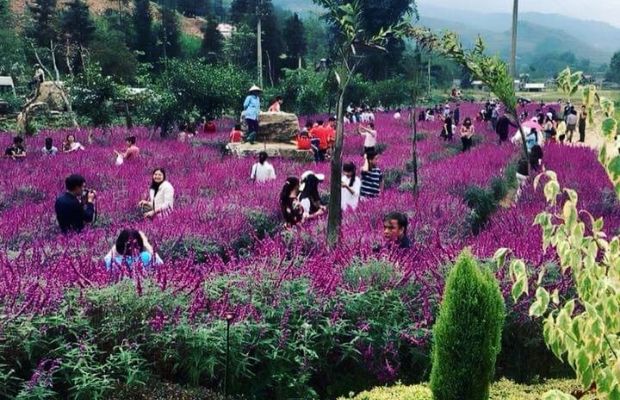
Bac Ha Flower Valley
Besides admiring the beautiful scenery, you can also enjoy the crowded atmosphere of the traditional festivals in the region. Some outstanding festivals include the Tay ethnic people’s field festival, the Mong people’s Gau Tao Festival, the forest worshiping ceremony of the Mong ethnic group, the Xen Ban and Xen Muong festivals of the Thai ethnic group, etc. Although these festivals have their own characteristics, they are associated with rice plants and people's livelihoods in common.
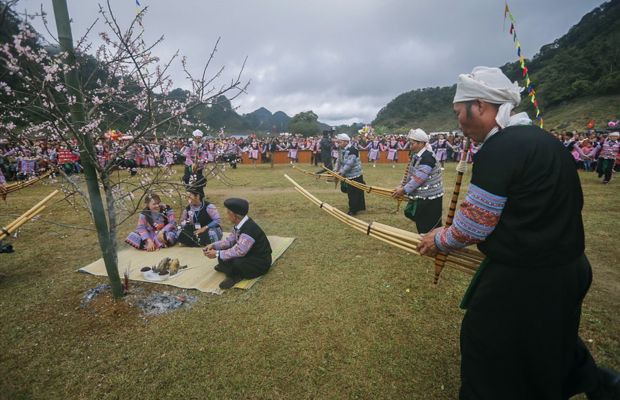
Gau Tao Festival
The region’s summer (April to July)
In the summer, the Northwest mountainous region has the Southwest monsoon, making the weather in the area hot and dry, with a lot of rain. The highest temperature during the day is around 30 degrees Celsius. The evening is cool. Traveling to the Northwest region of Vietnam this time, you can admire the stunning terraced rice fields in Sapa in the pouring water season, the azalea flowers in the Hoang Lien Mountain range, and the ripening plum in Moc Chau. Besides, there are many other exciting activities in the region in the summer.
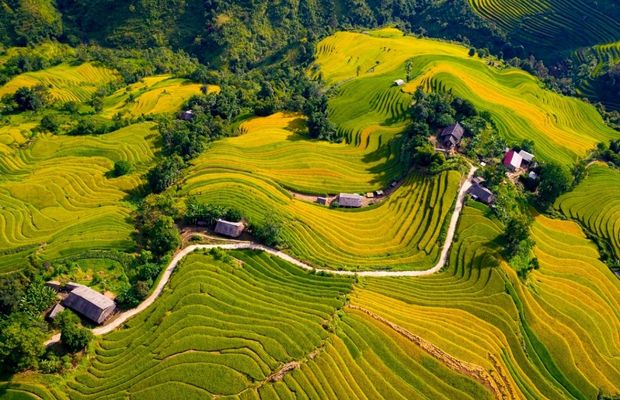
Terraced rice field in Sapa
The Northwest region of Vietnam in Autumn (August to October)
The average temperature of the region at this time is around 25 degrees Celsius. This is when the Northwest enters autumn, which is the best time to travel to the Northwest. Traveling to the Northwest region of Vietnam this time, you will have a chance to admire the yellow terraced fields in the ripe rice season. Sapa, Hoang Su Phi, and Mu Cang Chai are some of the best places to see the rice fields. Besides visiting these destinations to see the rice fields and traveling to the region in autumn, you may want to drop by Moc Chau to visit the persimmon gardens.
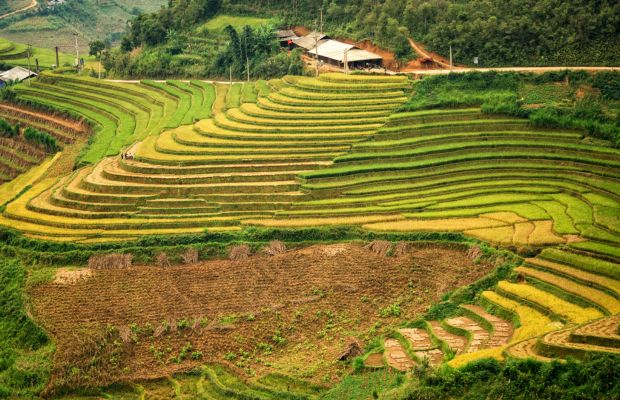
Terraced rice field in Mu Cang Chai
The Northwest region of Vietnam in Winter (October to December)
The winter in the Northwest region of Vietnam is extremely cold, the lowest temperature drops to 1 degree Celsius and there is ice and snow. However, this is an ideal time to see the white and yellow mustard flower fields of the Northwest mountains. Besides, there are also many festivals in the region, such as the winter festival in Sapa and Bac Ha, etc.
In general, the Northwest region of Vietnam is stunning all year round. So, you can arrange your time and travel to the region anytime you want.
Exploring outstanding destinations in the Northwest region of Vietnam
The Northwest region of Vietnam is exceptional, with many places of natural beauty and cultural significance. Let’s explore some outstanding destinations in the region with Handspan Travel Indochina!
Sapa
Located in the northwest region of Vietnam, Sapa is a famous hill station of Lao Cai province near the China border. This destination has been a popular destination for travelers both domestically and internationally for over a century. It's an amazing place that has everything a traveler is looking for: an amazing natural beauty with imposing mountains and green valleys, fascinating cultures and traditions of many hill tribes, and beautiful, pleasant weather all year round. Sapa is home to many well-known spots with unique and attractive features. Below are some attractions you should not miss.
- Fansipan Mountain
Fansipan Mountain is one of the attractions in Sapa where you can admire a panoramic view of this town. It is the highest mountain in the Indochina area, at 3.143 meters above sea level. To reach Fansipan Mountain Peak, you can climb or use a cable car.
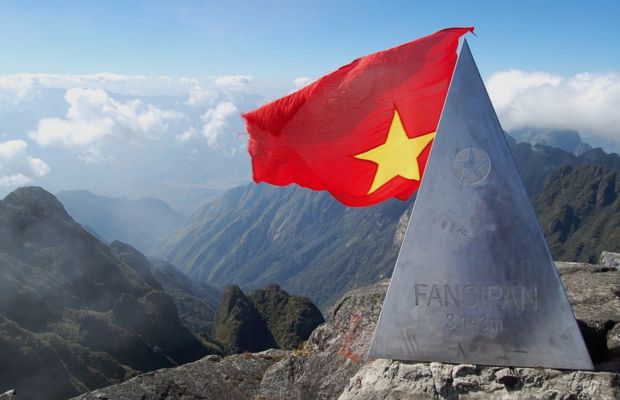
Fansipan Mountain
- Muong Hoa Valley
Muong Hoa Valley is also among the alluring attractions in Sapa you should not miss. The valley is located in Hau Thao Commune, about 10 kilometers from Sapa to the Southwest. It is one of the ideal attractions to admire the rice terrace field in Sapa. Coming here, you can see rice terrace fields curving along the hillsides. Whether in the pouring water season or harvesting season, you can still appreciate the stunning landscape.
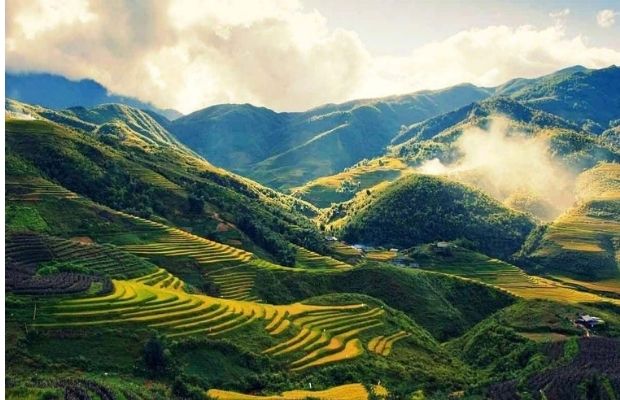
Muong Hoa Valley
- O Quy Ho Pass
O Quy Ho Pass is also known as Cloud Pass, as it is located at a height of nearly 2,000 meters above sea level, covered by clouds all year round. The O Quy Ho Heaven Gate (Cong Troi O Quy Ho) and O Quy Ho Glass Bridge (Cau Kinh O Quy Ho) are two famous stopovers to adore the clouds and majestic scenery.
- Sapa Stone Church
Located right in the town center, Sapa Stone Church is also one of the worth-visiting attractions in Sapa. The church was built in 1935 by the French, and it is the only intact imprint of the French in Sapa. Although Sapa Stone Church has been restored, its ancient Roman Gothic-style architecture remains untouched. This architecture is shown in the pyramid-shaped roof, bell tower, arch, etc. Inside the church is a chapel with 32 stained-glass windows with images of Saints and crosses.
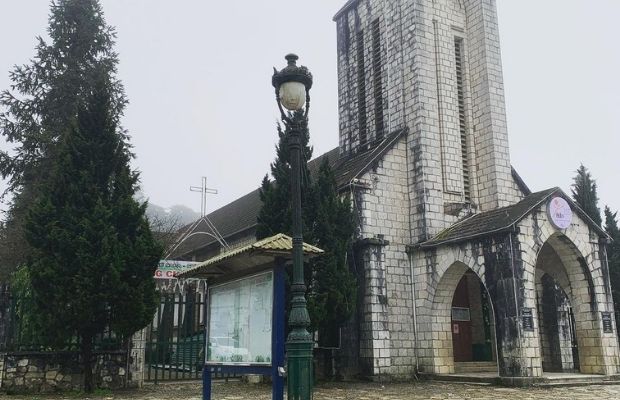
Sapa Stone Church
- Cat Cat Village
Cat Cat Village has many exciting things, from small paths, and simple wooden houses to colorful handicraft stalls. Coming to Cat Cat Village, you will see Hmong people cultivating, raising livestock, and preserving traditional handicrafts such as weaving, growing cotton, linen, indigo dyeing, and silver making. Rice farming and handicraft making are passed on from generation to generation.
For more attractions to visit in Sapa, one of the most amazing destinations in the Northwest region of Vietnam, please refer to our blog post here: The top 13 attractions in Sapa you should not miss.
Moc Chau
Moc Chau is located in Son La Province, one of the provinces in the Northwest region of Vietnam. Possessing the flavor of weather conditions, stunning natural scenery, and notable tourist attractions, Moc Chau has become a popular destination for both domestic and foreign tourists. Traveling to Moc Chau, you should not miss visiting these attractions below.
- Ban Ang pine forest
Ban Ang pine forest is located in the Ang village area of Dong Sang commune, Moc Chau district, Son La province, 2 km from the center of Moc Chau town along National Highway 43. With a total area of over 43 hectares including a towering green pine forest, stretching over red-brown hillsides and a cool lake, this place has become a new camping spot in the Northern region.
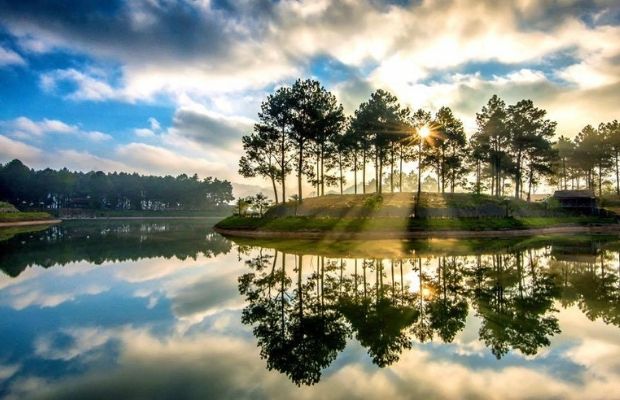
Ban Ang Pine Forest
- Na Ka Plum Valley
Na Ka Plum Valley is located on Provincial Road 104, Moc Chau Farm Town, Moc Chau District, Son La. This spot attracts a lot of young people to visit, especially in the spring, after the Lunar New Year every year. The scenery here is captivatingly beautiful with white plum blossoms covering the entire valley and the cool air. If you come to Na Ka Valley around March and April, you will be able to pick and enjoy the ripe, delicious plums yourself.
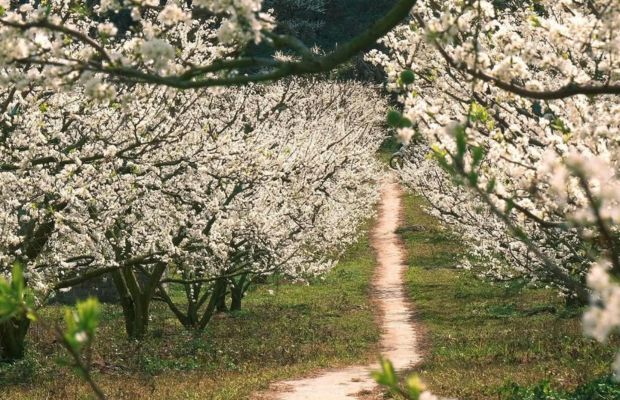
Na Ka Plum Valley
- Dai Yem Waterfall
Dai Yem Waterfall is an outstanding tourist spot in Moc Chau, in particular, and in the Northwest region of Vietnam, in general. The waterfall is also known as Nang Waterfall or Ban Vat Waterfall. The waterfall is located on Vat stream, which is formed from two streams in Vat village, a very old Thai village. Dai Yem Waterfall is massive with a height of more than 100 m, divided into 2 parts. The upper part has 9 floors and the lower part has 5 floors. The ideal time for you to explore the beauty of Dai Yem Waterfall is from April to October. At this time, a large amount of water from upstream flows down extremely strongly and rapidly, creating white foam day and night.
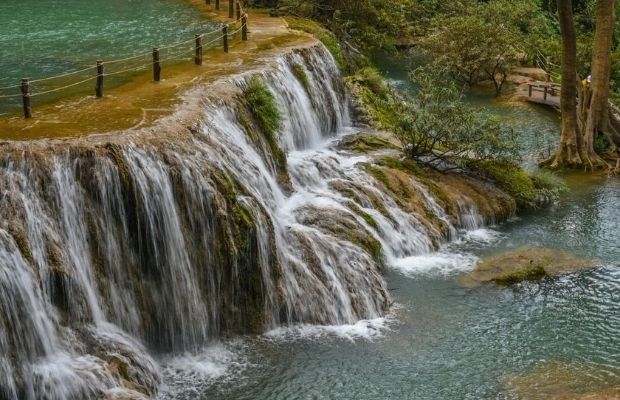
Dai Yem Waterfall
- Bach Long Glass Bridge
Bach Long Glass-Bottom Bridge is the latest glass-bottom bridge in Vietnam. The bridge belongs to the Moc Chau Island tourist area in Muong Sang Commune, Moc Chau District, Son La Province. With a total length of 632 meters, the Bach Long Glass-bottom bridge is now the world’s longest glass-bottom bridge, surpassing the 526-meter bridge in China. Bach Long Bridge is the highlight of the Moc Chau Island tourist area with a panoramic view of the mountain and surrounding landscapes. For more detailed information and exciting things, please refer to our blog post: Bach Long Glass-bottom Bridge in Moc Chau: The world’s longest glass-bottom bridge.
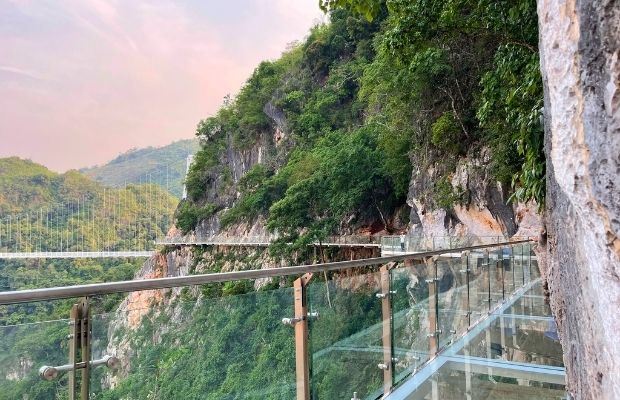
Bach Long Glass Bridge
Mu Cang Chai
Mu Cang Chai, located in Yen Bai Province, is one of the attractions in the Northwest region of Vietnam that you should not miss. September and October are two most ideal time to visit Mu Cang Chai, as you can immerse yourself in the stunning golden terraced rice fields. Terraced fields cover more than 2,200 hectares of land in Mu Cang Chai. Below are some amazing tourist spots in Mu Cang Chai.
- Khau Pha Pass
Khau Pha Pass, one of the most outstanding passes in the Northwest region of Vietnam, is located in Cao Pha Commune, Mu Cang Trai District, Yen Bai Province. From Yen Bai city, following Highway 32 for about 5 hours, through Tu Le commune, Khau Pha pass in Mu Cang Chai district appears in the middle of a plateau surrounded by overlapping mountain ranges. The winding mountain passes between the old forests still retain their pristine beauty and the terraced fields of the H'Mong and Thai ethnic groups.
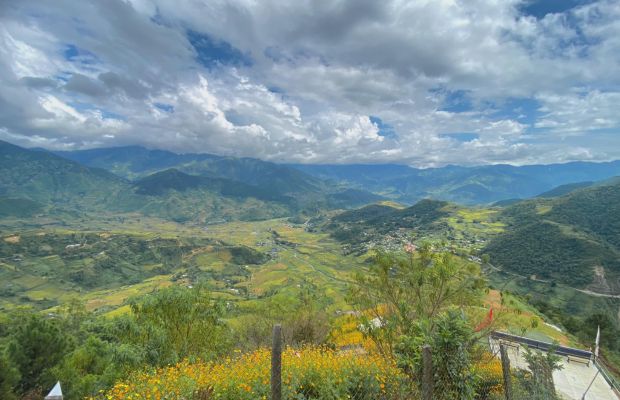
Khau Pha Pass
- Lim Mong, Lim Thai Valley
Lim Mong and Lim Thai valleys are home to Thai villages located in the valley right below Khau Pha pass. Coming to Lim Mong in September and October, you will be able to travel in the golden season with ripe rice fields on both sides of the road. You can ride their motorbikes between the golden rice fields, admire the peaceful villages in the harvest season, meet people from children to the elderly or play by the cool streams.
- Mam Xoi Hill
Mam Xoi Hill is the symbolic image of the golden season of Mu Cang Chai for many years. The hill is located in La Pan Tan, more than 8 km from the town center. The road to get here is quite difficult. Therefore, if you want to come here, you should rent a local motorbike taxi.
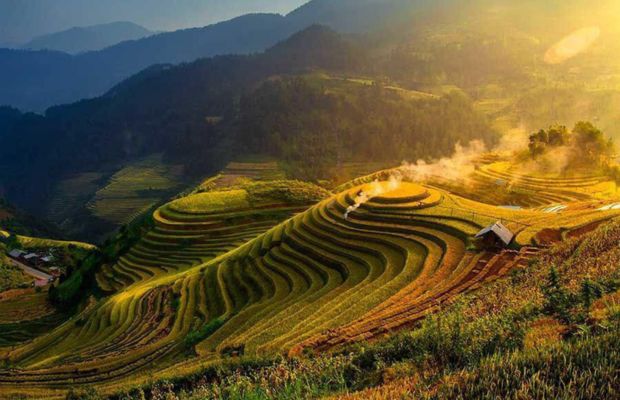
Mam Xoi Hill
Mai Chau
Mai Chau, only 140 kilometers away from Hanoi, is part of the mountainous Northwest region of Vietnam. This destination is extremely ideal for escaping from the city's hustle and bustle. At an average height of 900 meters above sea level (highest peak, 1,536 meters at Pa Co; lowest point, 220 meters at central Mai Chau town), Mai Chau has a highland tropical climate: high heat - hours of sunshine in the range of 3 in winter and 6 in summer; high humidity - 82% on average; a lot of rain - rainfall of 1,400 millimeters a year (rainy season from May to October versus dry season from November to April). If you are traveling to Mai Chau, you may want to visit the attractions below.
- Lac and Pom Coong Village
Lac and Pom Coong, two villages with some 170 households, are at the very heart of the area. Their friendly owners, the White Thai people, have been living here since their migration 700 years ago. Their living space, a house on stilts or a turtle house traditionally built just to fit nicely into a beautiful tranquil idyllic setting with surrounding high mountains, green forests, and paddy fields, is worth a visit.
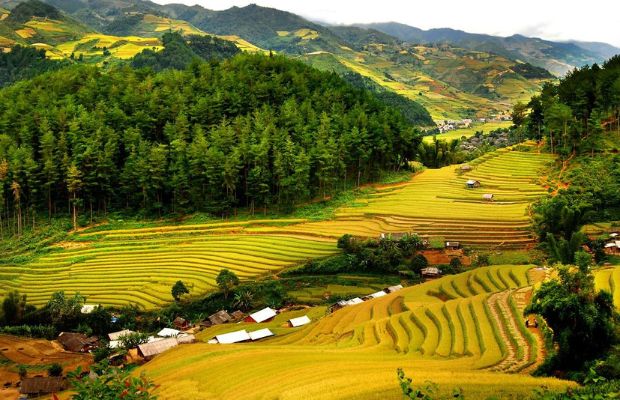
Lac Village
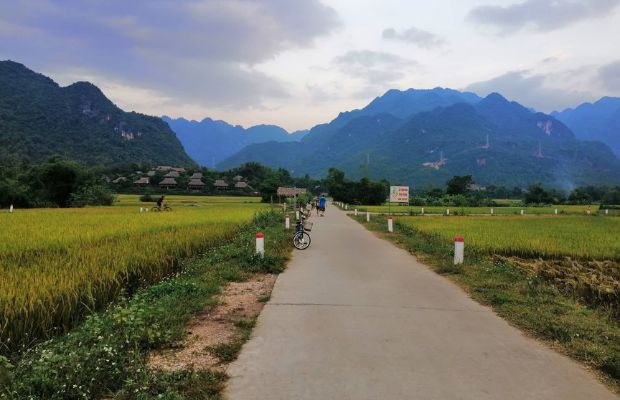
Pom Coong Village
- Thung Khe Pass
Between Tan Lac and Mai Chau, Thung Khe Pass, also called White Rock Pass, is at a height of some 700 meters in altitude, making it a good stop-over to enjoy a gorgeous typical view of karst formation settings from high above (weather permitting) and taste some local foods by the Muong. High and meandering, this pass occasionally brings those who are from lowland areas a new feel – into an ocean of mist.
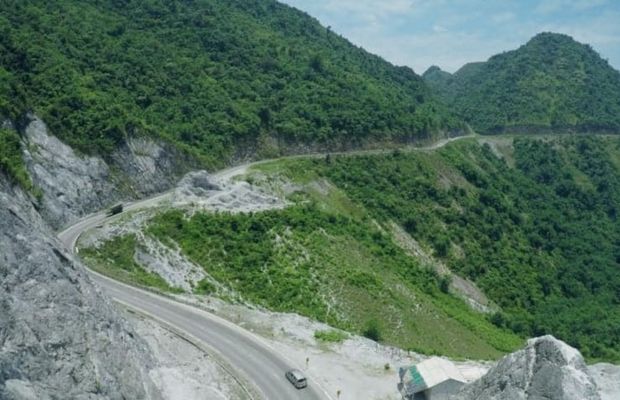
Thung Khe Pass
- Chieu Cave
Chieu cave is at the height of 250 meters above sea level, with its tree-covered 15-meter wide mouth. It is another choice for those who love nature-made cracks. To reach here, from Mai Chau town, head southwest to a sign that reads “To Chieu cave”. As many as 1200 steps are what travelers have to conquer. It is certainly tiring, but it is worth it because those who say “made it” get a better view of the valley from a different perspective.
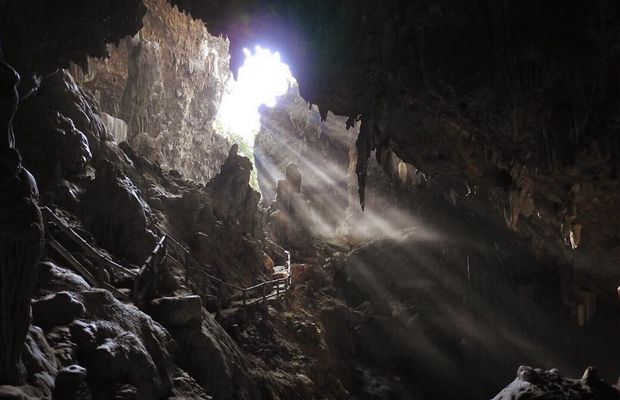
Chieu Cave
For more detailed information about Mai Chau and tourist spots in Mai Chau, please refer to our blog post here: Mai Chau travel guide.
Hang Kia Pa Co
Hang Kia Pa Co, belonging to Hoa Binh Province, is also an outstanding destination in the Northwest region of Vietnam. Most of the people in Pa Co are Mong people with many cultural values and traditional occupations that are still being preserved and conserved. Traveling to Hang Kia Pa Co, you will have a chance to be immersed in the simple life of the local people, participating in experiential tourism activities such as weaving, growing vegetables, dyeing fabric, picking tea, and making costumes. If you come here from October to April the next year, you can admire the floating sea of clouds.
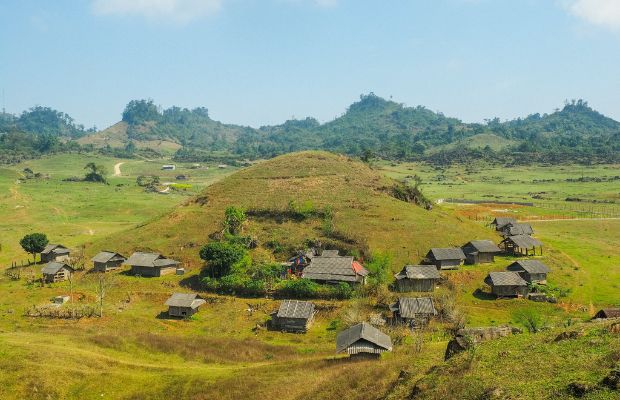
Hang Kia Pa Co
This destination is a large nature reserve with a total area of 5,258 hectares, covering the territory of all 6 communes in Mai Chau district: Hang Kia, Pa Co, Tan Son, Cun Pheo, Bao La and Pieng Ve. The terrain of Hang Kia Pa Co is typical limestone mountains. Currently, the reserve has more than 300 species of plants, including many rare species such as dieffenbachia, palm trees, pine trees, etc. In addition, this is also home to many rare animals such as bears, tigers, leopards, peacocks, etc.
Dien Bien
Dien Bien, 450 kilometers from Hanoi, is also one of the worth-visiting destinations in the Northwest region of Vietnam. This destination is the witness of Vietnam’s victory at the battle of Dien Bien Phu in 1954. Besides its historical meanings, Dien Bien also attracts tourists through the natural beauty of numerous caves, mineral water sources, lakes, and cultural characteristics of ethnic groups. It is home to 21 ethnic minority groups; among which the Thai ethnic group is the most populous, accounting for 38.4% of the province's population. Below are some spots in Dien Bien that you should not miss.
- Pha Din Pass
Pha Din Pass is located on National Highway 6, 32km long, connecting the two provinces of Dien Bien and Son La. The highest point of the pass is 1,648m with rugged terrain, one side is a cliff, and the other side is a deep abyss. The winding road uphill has many dangerous turns. At the foot of the pass is a valley with poetic, peaceful villages. Next to it are green corn fields, golden terraced fields that are breathtakingly beautiful.
- A1 Hill
Located in Muong Thanh Ward, A1 Hill is among the attractions in Dien Bien that you may want to visit to learn about the history of Vietnam. Around A1, the French army built a system of barbed wire fences of various shapes. The battle on A1 hill was fierce, prolonged and resulted in many casualties. On hill A1 there are still traces of the explosion crater created by 960 kg of explosives.
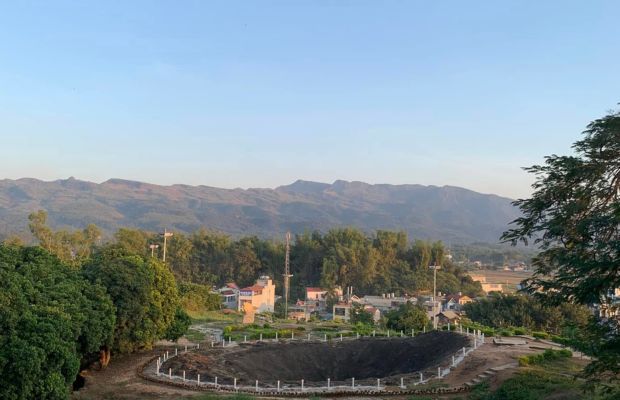
A1 Hill
- General De Castries Bunker
The command bunker of General De Castries was built by the French colonialists in the center of the Dien Bien Phu stronghold, in the Muong Thanh field. The bunker is located about 1 km from A1 hill, and is known as "the most fortified bunker in Indochina". Surrounding the bunker is a defensive fence with a dense barbed wire system and four tanks. The structure and layout of the bunker are still preserved for visitors to see. The bunker is 20 meters long and 8 meters wide, consisting of four rooms used for both living and working for General De Castries and his soldiers.
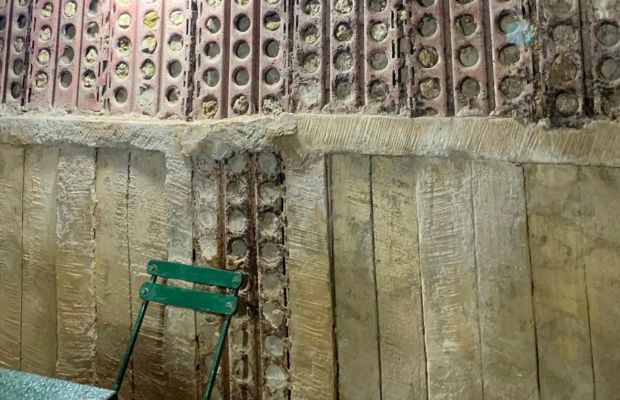
General De Castries Bunker
- Dien Bien Phu Victory Museum
Dien Bien Phu Victory Museum is a work of great historical, cultural, and artistic significance. The museum is designed in the shape of a truncated cone, decorated in the shape of a diamond symbolizing the camouflage net of a soldier's helmet, and includes a basement and a ground floor. The basement is where visitors are welcomed, a space for learning, interaction, and entertainment services. The ground floor is a space for displaying the Dien Bien Phu victory. The ground floor has an area of 1,250 m2 with nearly 1,000 documents, artifacts, images and maps.
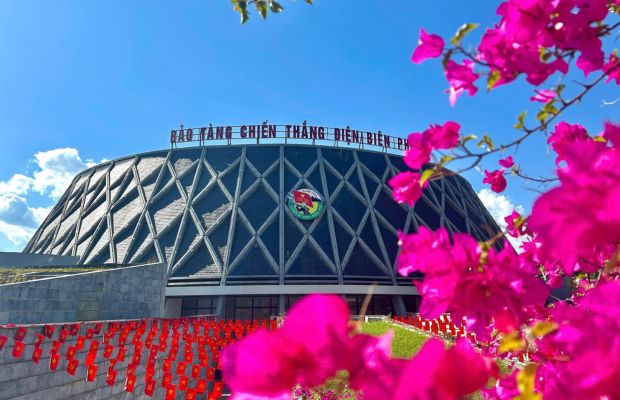
Dien Bien Phu Victory Museum
Lai Chau
Lai Chau is also among the destinations you should travel to in the Northwest region of Vietnam. Coming to Lai Chau, you can immerse in the wild natural beauty of the cloud peaks, enchanting waterfalls, and golden rice fields and impress with the warm-hearted and hospitable people. Lai Chau is located between two extremely famous tourist destinations of the Northwest: Sa Pa (Lao Cai) and Dien Bien. You will have a chance to admire the spectacular and pristine landscapes of the Northwest mountains and forests. Below are some attractions to visit in Lai Chau.
- Sin Ho Plateau
Sin Ho Plateau is the roof of Lai Chau province, about 60 km from Lai Chau city center, stands at an altitude of about 1500m. It is an attractive destination full of promises of wonderful experiences that visitors cannot miss.
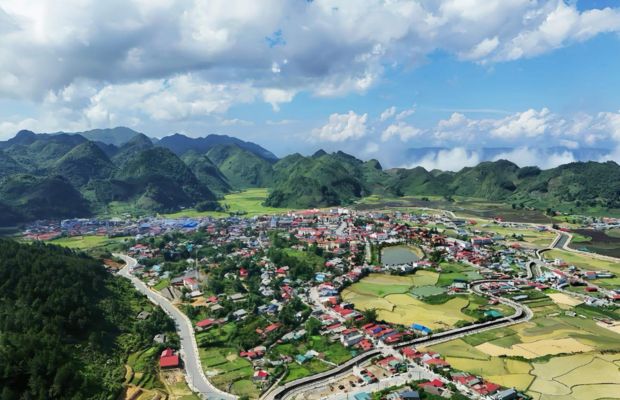
Sin Ho Plateau
- Sin Suoi Ho Village
Sin Suoi Ho Village, about 30 kilometers from Lai Chau City, is an amazing spot in Lai Chau in particular and the Northwest region of Vietnam in general. It is located at an altitude of nearly 1,500m above sea level, the natural landscape is very beautiful, and the climate is cool all year round. Sin Suoi Ho is called "Paradise in the Clouds" because when coming here, you will be immersed in the sea of clouds every early morning. Besides, you can soak in the cool water of Love Waterfall, and Heart Waterfall, admire the terraced fields with the fragrant scent of ripe rice, etc.
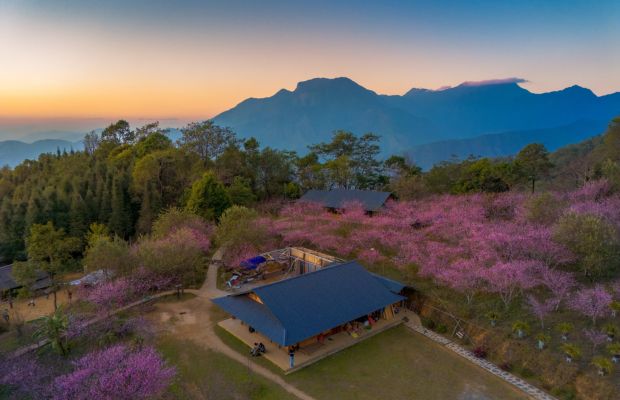
Sin Suoi Ho Village
- Si Thau Chai Village
Si Thau Chai Village, located in Ho Thau Commune, Tam Duong District, Lai Chau, is also worth visiting. This peaceful village is home to more than 60 Dao ethnic households. Standing from the village, looking far away, you can see the whole town of Tam Duong with its vast and majestic mountains and forests. Besides admiring natural scenery, you can experience the local culture when visiting the village. You will have a chance to experience with the Dao people in the Cap Sac Festival, and Fire Dance Ceremony and enjoy the cuisine of the highland people.
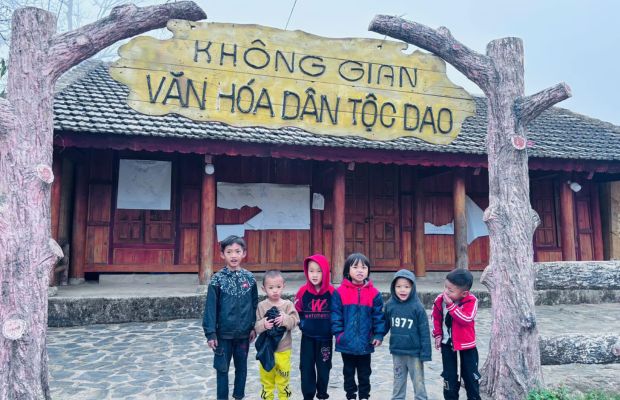
Si Thau Chai Village
Enjoying specialties in the Northwest region of Vietnam
The Northwest region of Vietnam is not only attractive by the natural scenery and cultural diversity but also by the unique culinary features. Let’s see some specialties in the region with us!
Pa pinh top
Pa pinh top, one of the most delicious dishes in the Northwest region of Vietnam, is the name of grilled stream fish of the Thai ethnic group. This dish not only has high culinary value but is also a measure of the skillful hands of the cook.
Thang co
Initially, only the Hmong people made Thang Co. However, this dish was later introduced to other ethnic groups such as Kinh, Dao, Tay. Traditional Thang Co is cooked with horse meat. Later, local people add beef, buffalo meat and pork to the dish. Traditional spices include salt, cardamom, di dien, cinnamon, and lemon leaves.
Thit trau gac bep (Buffalo meat upstairs kitchen)
Thit Trau Gac Bep, or dried buffalo, is also among the specialties in the Northwest region of Vietnam that you should not miss. It is a unique food of Black Thai people. Trying this food, you will feel the forest in a few days. After seasoning, fresh buffalo meat will be smoked until the unique taste of different species such as cape yellowwood seed, salt, pepper, garlic, and ginger infiltrate the buffalo meat. Besides, the distinct smell from the smoke of the kitchen combined with spicy lemon pepper salt is also addictive.
Grilled chicken with Northwest wild pepper
Grilled chicken with Northwest wild pepper is also among the food in the Northwest region of Vietnam that you should try. From the selection of ingredients, seasoning to the way of grilling the chicken, all require meticulousness, care and thoughtfulness. Local people choose free-range chicken, with firm, delicious meat. Wild pepper is picked from old forests, carrying a characteristic spicy flavor. The chicken is seasoned with just the right amount of spices. Then it is grilled on a charcoal stove until the chicken skin is golden and crispy. After that, the cook will cook the chicken evenly and give off a fragrant aroma.
Grilled stream fish
Grilled stream fish is also among the delicious dishes in the Northwest region of Vietnam. Northwest stream fish is a special dish made from natural fish, living in rivers and streams in the Northwest mountains. The fish meat is chewy, firm and more fragrant than other types of fish. To create a delicious dish from Northwest stream fish, the process and selection of suitable herbs as well as the marinating of the fish must be followed and use the typical spices of the mountains and forests.
Tips to know before traveling to the Northwest region of Vietnam
Traveling to the Northwest region of Vietnam offers a unique and culturally enriching experience. Let’s follow these tips to make the most of your trip.
Pack appropriate clothing
The weather in the Northwest region of Vietnam can vary, so you should pack accordingly. You may want to check the weather before traveling so that you can bring suitable clothes. Besides, a light rain jacket and sturdy shoes for trekking are essential for your trip here.
Check permits to visit an attraction
Some areas near the border may require special permits. Check in advance and ensure you have the necessary documentation to avoid any complications during your travels.
Respect the locals
The Northwest region of Vietnam is home to various ethnic minority groups, each with its own customs and traditions. Respect their way of life, ask for permission before taking photos, and follow cultural norms when interacting with locals.
Prepare essential items
Besides clothes, there are many other essential items you need to prepare. Some basic medicine includes headache, cold, and digestive medicine. Besides, you also need offline map or map app because some places don't have phone signal.
In conclusion, you have just known detailed information about the Northwest region of Vietnam. If you want to book a tour in the region or tailor your itinerary, don’t hesitate to contact our team.